
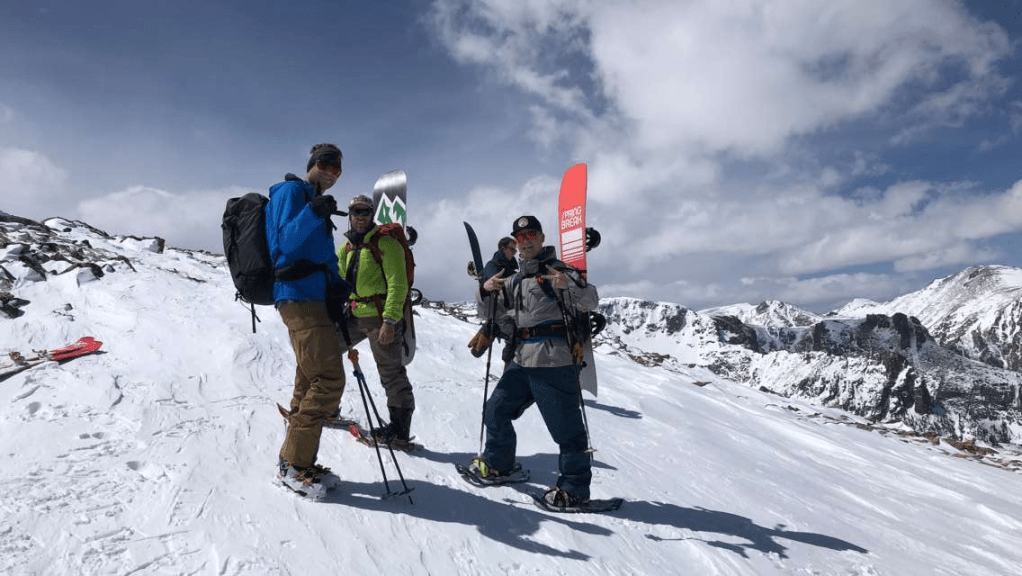
RMNP. Our guide Mike on the left, my backcountry partner Nate on the right, and other members of our group in between.
I first heard this term during an avalanche safety training course in Rocky Mountain National Park. Our instructor, Mike Coyle, was guiding our group on our way up to Banana Bowls and was speaking about efficiency, technique, and pace, all of which are closely interrelated. On dry land, sprinting and bounding up a hill might get one to the top faster, but it might not be the most efficient way to get to the top.
In a backcountry setting, efficiency is defined as the most ground gained in relation to calories expended – bang for buck. Technique is defined as how one moves their body – form. Pace is defined as how quickly one is moving both in distance and in vertical feet gained over time. All three of these are combined into the concept of the Economy of Movement, also known as the Motion Economy in workplace settings. In the backcountry, the economy of movement is vital to ensure a successful tour. Burn resources too quickly, there is a risk of failure, whether that be muscle fatigue, hydration and food shortages, or group separation.
A successful tour, penultimately, is where everyone in group returns safely, regardless if the planned route is completed.
Efficiency
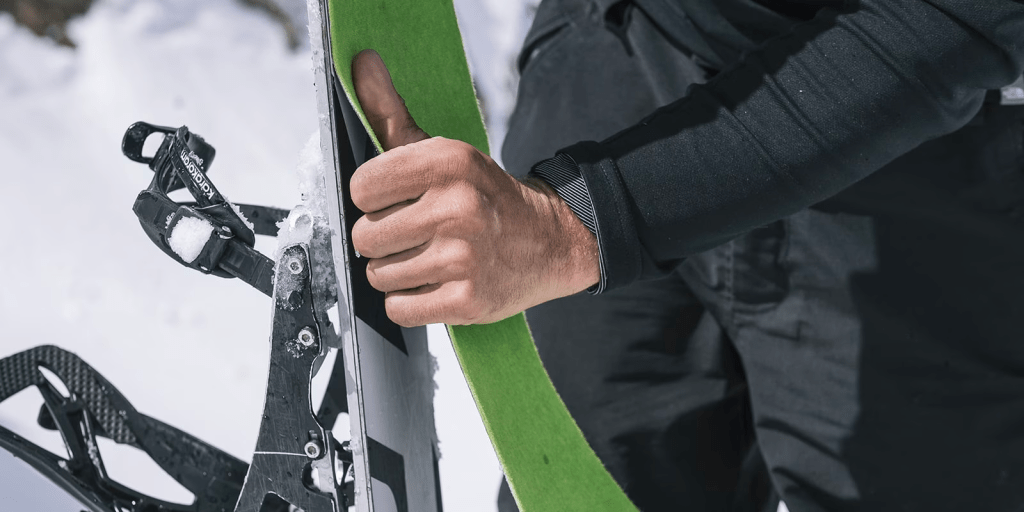
Attaching a splitboard skin.
There are several modes of travel in the backcountry. Snowshoeing, bootpacking, and skinning are the most common. Skinning, where the base of a ski or splitboard is covered in a directional fur-like material that slides one way and holds in place the other, is the most efficient on the way up, because one can slide their ski rather than picking it up off the ground. Very important, especially as backcountry setups are heavier than resort setups, even more so the splitboard I like to use. Keeping that weight off the back and on the ground saves a ton of energy.
Technique
Form is key to conserving energy as well. Proper skinning form is akin to gliding, rather than stepping. This is easy to learn, hard to master. A proficient skinner can maintain a fast pace for much longer than a newbie who is picking their feet up, at many less calories expended.
Pace
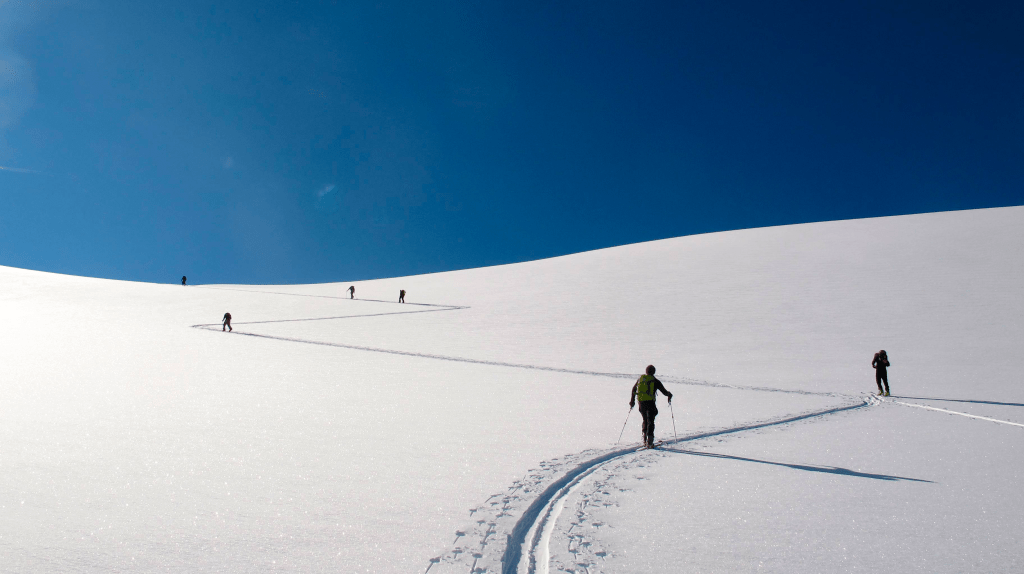
A typical skintrack with switchbacks.
Pace, and route selection, as one of the most important parts of tour, and this involves up-front planning. What are the fitness levels of the group? A comfortable pace for one person may be too fast for another. What is the route? A skin track that switchbacks often results in a slower pace, but it conserves energy as the vertical feet gained is spread out over a longer distance.
Rescue Scenario
While the group dynamics involved with backcountry travel are complicated and worthy of a future post, the economy of movement can be applied to more than just the skin up and the ski down.
In an avalanche rescue setting, moving quickly is key, because life is at stake
Statistics show that 93 percent of avalanche victims can be recovered alive if they are dug out within the first 15 minutes, but then the numbers drop catastrophically. After 45 minutes, only 20-30 percent are still alive and after two hours almost no one is alive.
https://utahavalanchecenter.org/education/faq
Related to the economy of movement, two pieces of advice stuck with me. Firstly, moving methodically down the slope towards the point last seen. Moving downhill is much less effort than moving uphill, so in a search for a partner swept by an avalanche, one does not want to get below where they are buried.
Secondly, ensuring recovery gear is easy to access and is used in the proper order. Searchers may have removed gloves while using their avalanche beacon. Once a burial site is located, ensuring that those gloves are on before starting to dig. Dig with exposed hands, they’re going to get cold – really cold. Cold enough that digging has to stop to locate the gloves and put them on, losing precious time.
Economy of Movement in other sports, and in work
Once this concept is understood, it can be seen everywhere.
In the NBA, Giannis Antetokounmpo going coast to coast in 3 dribbles is an example of scoring two points with minimal energy expenditure (at least in relation to his size!).
In boxing, MMA, martial arts, if a fighter throws a bunch of haymakers in round one, they may be so tired in later rounds they are easily beaten – if their opponent survives the initial onslaught. h/t Adam Townsend
In the workplace, economy of movement abounds. In dentist offices, reaching a tool without having to move another saves time and energy. In manufacturing, reducing rework and improving flow results in increased profits for the company, and more jobs created. Beautifully described by Randall Slimp at Howl Campfires.
In a less physical sense, arguing a malformed or under-formed thought on slack vs. writing an agenda and email to flesh out the thought, then discussing in person, saves immense mental energy.
I think about this a lot in my current role. How can I improve the flow of work for my teams and clients? What touchpoints are necessary for planning and decisions, and which are redundant and can be removed? Do we have too many systems giving different answers delaying effective decision making?
I hope this has been an enlightening and thought-provoking read. Thank you for reading.
 Pat Kinne